

The best landscaping around a tree in a lawn is a wide, flat ring of mulch. Make it 2 to 4 inches deep, pull it back a few inches from the trunk, and run it as far out toward the drip line as you’re willing to give up grass. No mulch piled against the bark, no new soil dumped on the roots, and no grass growing right up to the trunk. That one ring keeps the mower and the string trimmer off the bark, and it takes a slow lap out of every mow.
Why the Trunk Is the Weak Spot
One of the most dangerous pests of trees is humans, especially humans with equipment. Ouch. But fair.
Where does the damage happen? Usually at the root flare, the spot where the tree meets the turf and gets in the path of the mower or trimmer. Right behind the bark there’s a thin transport layer that moves water and nutrients between the roots and the leaves. And if you hurt that layer, the tree has a problem.

On young, smooth-barked trees like maples and birches, the bark can be less than 1/16 of an inch thick. That’s not much protection against string trimmers and mowing equipment. Hold your trimmer against that bark and you’re not tidying up (you’re peeling it).
Every tree wound is serious and the damage is irreversible, no matter its size. Small wounds add up when they happen every week. Each one lets in decay fungi. And if the damage goes all the way around the base (girdling), the tree dies. The trees that get hit hardest are the young, newly planted ones, which are also the ones with the thinnest bark.
Bad combination.
So the goal of everything below is simple. Keep the blade and the trimmer line off the trunk, for good.
The Mulch Ring: How Deep, How Wide and How Far From the Bark
Depth first, because it’s where people overdo it. A 3- to 4-inch layer of wood chips or shredded bark is right around trees on well-drained ground. On heavy soils, go 2 to 3 inches, because a deep layer there can waterlog the soil and keep oxygen out. Composted stuff goes at 2 to 3 inches and coarse mulch at 3 to 4.
Keep the mulch at least 3 or 4 inches back from the trunk, and 6 if you can spare the room. Mulch piled against the trunk can invite rot and rodents.

Width is the easy part. Take the ring as wide as the drip line, the edge of the canopy, because the larger the mulch ring, the better. If that’s more lawn than you want to give up, use the 3-3-3 method many arborists recommend for mature trees. That’s at least 3 inches from the trunk, no more than 3 inches deep, and 3 feet in diameter to cover most of the root zone. Think of 3 feet across as your floor, not your goal.
What goes in the ring matters a bit too. A medium-coarse mulch like hardwood chips is best, because a fine mulch can hold too much moisture, and plastic or weed barriers keep oxygen from getting to the roots.
So skip the plastic. Yeah, even under the mulch where nobody sees it.
If you’re stuck choosing a mulch, see what kind of mulch is best for landscaping.
Volcano Mulch Is the Mistake on Every Street

You’ve seen it. A tall cone of fresh mulch packed up the trunk, like the tree is wearing a skirt. That’s a mulch volcano.
It looks tidy. It isn’t.
Mulch should never touch the trunk at all. Piled against the bark, it traps moisture, invites decay and gives insects and disease a way in. It also buries the root flare, which is supposed to stay visible above the soil so the roots get oxygen. Tree bark works best in the air and light, and once you bury it in dark, damp mulch, it starts to rot.
The depth hurts too. More than 4 inches can push the tree to grow roots out of the trunk instead of the root system, and over time those roots can wrap around the trunk and girdle it. Weirdly, a deep, fluffy pile is also a vole hideout, with cover right up against the bark where they can chew it. A volcano also builds up heat and coaxes roots to grow up into the mulch instead of down into the ground.
Your ring should look like a bagel, not a muffin. Or a donut, not a volcano. Same idea. Flat, with a hole in the middle.
For a volcano that’s already there, cheapest check first: pull the mulch back with your hands until you can see where the trunk flares out into roots, then pull back anything piled against the trunk by several inches and check the depth. If there’s already enough, just rake it to freshen the look and break up any matted layer. No new bags needed (your wallet will like that part). Bark mulch breaks down slowly, so a lot of trees already have plenty and only need a light sprinkle on top.
Planting a Bed Under a Tree Without Burying the Roots
It’s tempting to circle a big tree with landscape block, fill the ring with a few bags of topsoil and plant some flowers. Turns out that’s one of the worst things you can do to it.
How much soil should you add for a raised bed around a tree? None. As little as an inch of soil can kill some trees, and the damage from changing the soil level won’t show up for 5 years or more. Then the tree slowly declines: stunted new growth, leaves coloring early in the fall, and death 5 to 10 years later. By then, you won’t connect it to the flower bed at all.

Use organic mulch instead, or perennial flowers and groundcovers planted in the existing soil. It’s less work, too. Small plants go in small holes, right in the soil that’s already there, with mulch around them at the same depths as the ring. The tree keeps its grade, and you still get something nicer to look at than bare chips.
Mowing and Trimming Around Trees Without Scarring Them
Once the ring is in, your mower’s job gets easier, and that’s not a side benefit. It’s the point. Mulch gives you a physical and visual buffer that keeps mowers and trimmers at a safe distance from the trunk and roots. Remove the turf at the base of the tree, or keep grass and weeds from growing there at all.

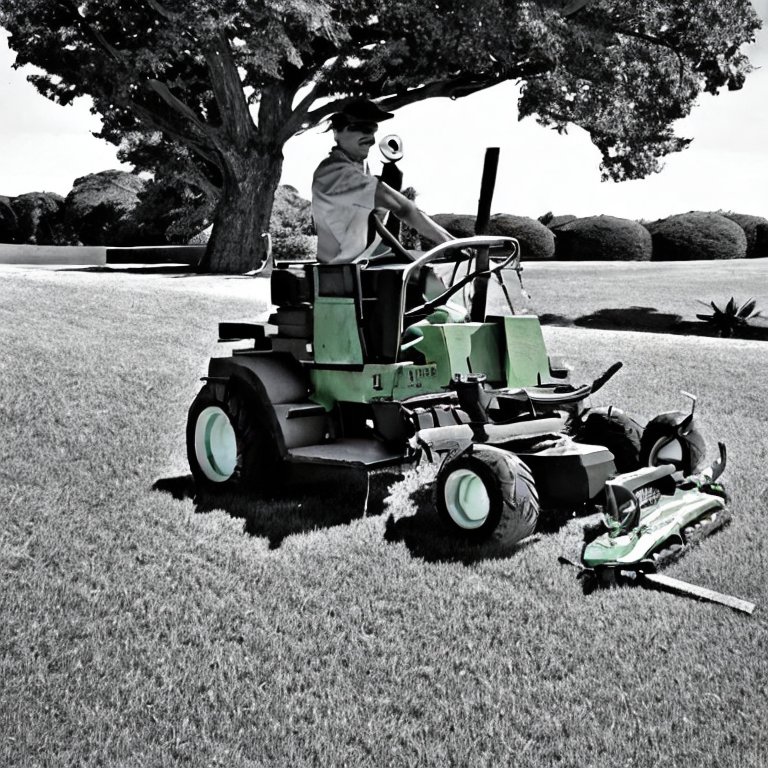
Mow around a ring the way you’d mow around a bed, one lap with the deck’s edge running along the mulch line. With a ring, there’s no reason to get in close to the trunk.
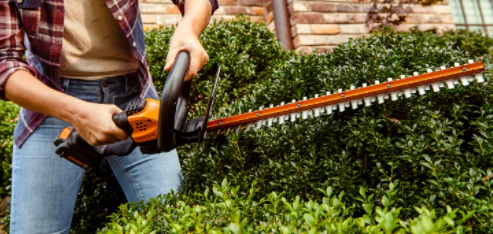
The string trimmer is the other danger, honestly. With a ring, it stays at the outside edge of the mulch and never goes near the bark. Some people spray herbicide around the base to cut down on mowing, with care and by the label. You can skip it. The ring kinda does that job already, without a sprayer anywhere near the roots.
Keeping the Ring a Ring, Year After Year
A ring isn’t a one-time job, but it’s close. Mulch breaks down, so the depth drops over a season or two. Wait until the old layer has broken down before you add more, and check under the mulch now and then for rodents and other pests that moved in. That second part is easy to skip. Don’t.

One thing that spooks people: a bright yellow blob on the mulch after a warm, wet week. That’s dog vomit fungus (great name). It shows up as fungus breaks the mulch down, and it won’t harm your plants. If it bugs you, break it up and let it dry out.
For topping it up, look at what falls off the tree. Leaves work as mulch, alongside wood chips, pine needles and bark, and mulching leaves with a lawn mower shreds them, so they tend to mat down less than whole ones. Free mulch.
Keep the edge crisp, too. The thing is, the grass will try to creep back into the ring every summer, and a soft, fuzzy edge is what tempts you to grab the trimmer and clean it up close to the trunk. A clean line between lawn and mulch tells the mower where to go and tells you where to stop.
Pick one tree this weekend and strip the grass in a circle at least 3 feet across. Keep the mulch 6 inches off the bark and lay 3 inches of hardwood chips. Plant nothing that needs new soil, and leave the trimmer in the shed. After that, the deck has no reason to touch that trunk again.
Sources: Iowa State University Extension, “How deep should the mulch layer be around trees and shrubs?”; University of Vermont Extension, “Beware the Mulch Volcano”; University of Illinois Extension, “Too much mulch can kill your tree” and “Proper Mulching Techniques”; Purdue Extension Forestry and Natural Resources, “Mechanical Damage to Trees: Mowing and Maintenance Equipment”; Melinda Myers, “Creating a Raised Bed Under Tree”; Penn State Extension, “Leaves Are Treasure, Not Trash”.
Sources checked November 12, 2026.