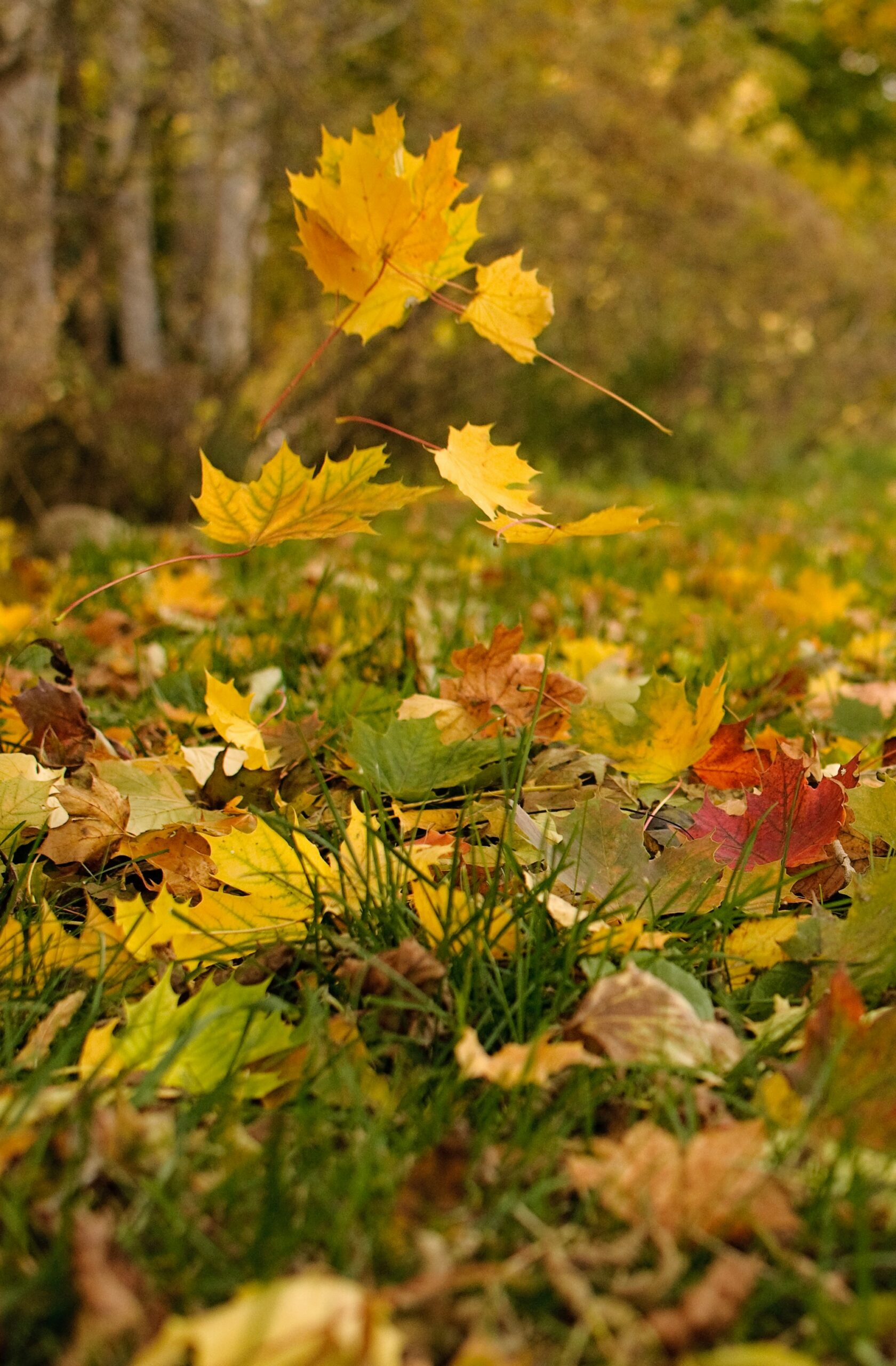

I quit bagging leaves about the same year I bought my zero-turn, and my lawn hasn’t looked any worse for it. Most of the leaves on an ordinary yard can go right back into the grass with the mower you already own. You need dry leaves and a sharp blade, plus a little patience with the thick spots.
I take care of about an acre with a riding mower, a zero-turn and an old push mower for the tight corners, and the snowblower is already parked by the garage door waiting its turn. I’m not a certified small-engine tech. What follows is what Michigan State University’s turfgrass researchers found when they mowed leaves into test plots for most of a decade, plus what I do on my own lawn every October, and I’ll keep the two apart.
The quick answer goes like this. Mow over the leaves while they’re dry and you can still see grass between them. Keep the deck at your normal fall height or a notch higher, and go slow. Make a second pass where they’re thick. Rake only the deep drifts, and put those leaves in the flower beds or on the compost pile instead of in bags at the curb.
What Michigan State Found When It Mowed Leaves Into Grass
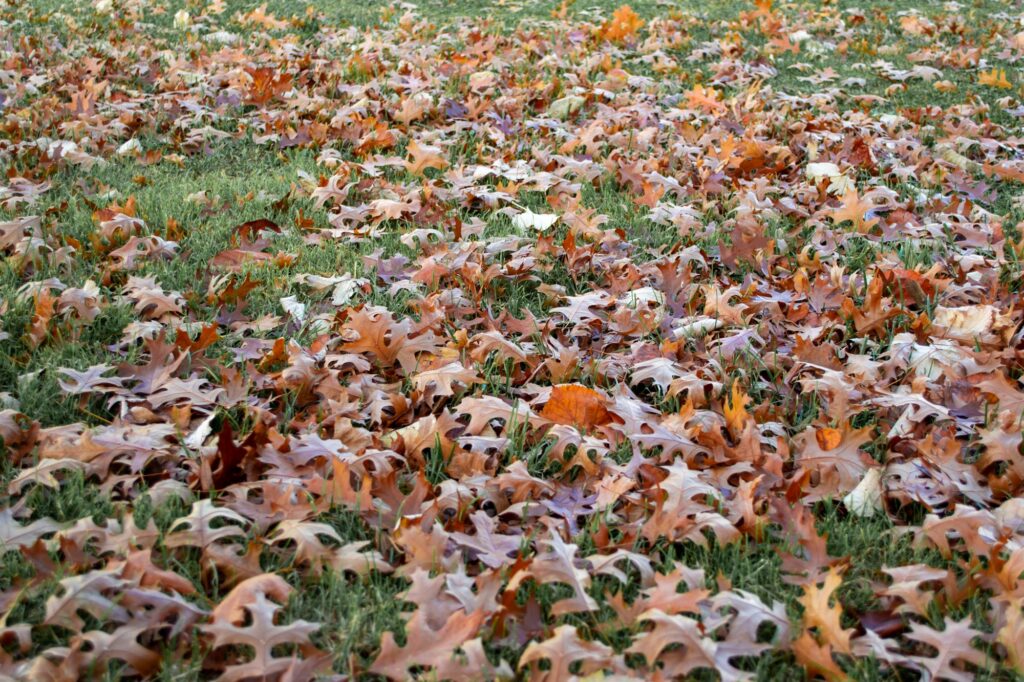
Since 1990, Michigan State has run three leaf-mulching studies at its Hancock Turfgrass Research Center. Thomas Nikolai and his colleagues in the Crop and Soil Sciences Department wrote up the results in the university’s Turfgrass Cultural Practices Report.
The first study chopped 50 and 100 pounds of dry leaves per 1,000 square feet into existing turf, and it tested whether nitrogen fertilizer would speed up the breakdown. It ran until 1996. The verdict was no negative effects from mulching the leaves in at those rates, and the nitrogen didn’t help the leaves break down any faster.
The second study is my favorite. Starting in October 1991, the researchers mowed oak leaves into some plots and maple leaves into others, 100 pounds of dry leaves per 1,000 square feet, into Kentucky bluegrass with a rotary push mower. Nothing fancy. It ran until the fall of 1998. Soil pH didn’t change under either kind of leaf. The maple plots actually rated better on turf quality, because fewer broadleaf weeds came up in them.
Soil cores pulled in the fall of 1998 showed more organic matter in the thatch where leaves went in, 8.9 percent with oak and 8.4 percent with maple, against 7.5 percent on the plots that got no leaves. Clippings from the leaf plots carried a bit more carbon and nitrogen too, and the carbon-to-nitrogen ratio sat at 13 on all three. In plain words, the leaves fed the soil without stealing the nitrogen the grass needs.
The oak worry is the one I hear most at the dealer when I’m picking up parts. People figure oak leaves will sour a lawn. Over seven years of oak leaves at 100 pounds per 1,000 square feet, the MSU team saw no change in soil pH. That’s one study on one soil, but it’s a long one.
As for why it works, Nikolai’s article “When Leaves Turn Into Litter” says rotary mowers cut leaves into small pieces that fall into and beneath the grass instead of resting on top of it. More surface area makes the pieces easier for insects and microbes to eat. He also wrote that Scarsdale, New York, was spending about $600,000 a year to collect and dispose of its residents’ autumn leaves. My town doesn’t bill me for leaf pickup, but my back would.
How Deep Is Too Deep

The third study answers the question I get asked most, which is how many leaves is too many. In October 1995, MSU started mulching a mix of tree leaves into a sunny lawn of Kentucky bluegrass, perennial rye and fine fescue. They picked three heavy rates on purpose: 150 pounds, 300 pounds and 450 pounds of dry leaves per 1,000 square feet. Nikolai’s article puts the lightest rate at about a 6-inch layer before mowing, and the heaviest at about 18 inches.
Those plots never got a lick of fertilizer in the three years the study ran. After the leaves went in, the grass was mowed at 2.5 inches for the rest of the year. Then on March 31, 1998, the researchers recorded how much of each plot still showed leaves.
At 150 pounds, only 3 to 5 percent of a plot showed leaves that spring. At 300 pounds, it was 6 percent where they’d mulched with the deck at 3 inches and 21 percent with the deck at 1.5 inches. At 450 pounds, about half the plot still had leaves showing, 51 percent at the low deck and 47.7 percent at the high one. And here’s the line that matters: the report says all the visible leaf litter soon went away once the grass started growing in the spring.
The soil held up too. The carbon-to-nitrogen ratio in the top 3 inches stayed well below 30 to 1 at every rate, between 14.2 and 14.8 on the leaf plots and 12.7 on the plots with none. Above 30 to 1, the report says, you’d need to add nitrogen to keep it available to the grass. The leaf plots even had a softer surface. In July 1999 a Clegg impact hammer, a gadget that measures how hard the ground is, read 61 on the bare plots and 44 to 51 on the leaf plots.
I read it this way. A test plot isn’t your front yard, and I’d never pile on 450 pounds on purpose. But a normal fall, even a heavy one under a big maple, is well inside what grass handled there. Nikolai went further. He wrote that turfgrass can take up to three times the load that farm fields are legally allowed, and he noted that New Jersey, which spreads town leaves on farmland, caps those at a layer 6 inches deep.
Set Up the Mower: Deck Height and Blade
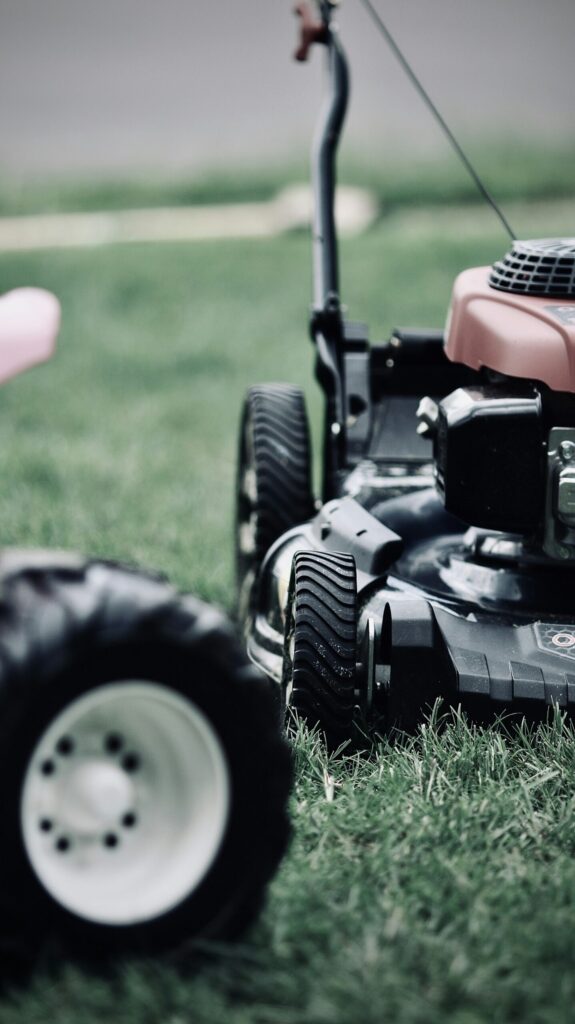
You don’t need a special machine. The oak and maple study used a plain rotary push mower, and the heavy-rate study used a mulching mower. Whatever’s in your garage with a spinning blade under a deck will chop leaves.
Deck height is the one setting worth a thought. In the third study, the plots mulched at 3 inches showed less leaf litter the next spring than the ones mulched at 1.5 inches, and the gap was biggest at 300 pounds. The report doesn’t say why. My guess is that taller grass gives the leaf bits more room to drop down out of sight, but that’s a guess, not a finding.
So I don’t drop the deck to scalp the leaves up. I mulch at my usual fall height, right around 3 inches on all three mowers, and I go slower than I would for plain grass. Ground speed matters more than throttle. Full throttle at a walking pace gives the blade time to hit each leaf more than once.
The blade itself matters more than people think. A dull blade tears leaves into big ragged flakes that sit on top of the grass. A sharp one leaves pieces about the size of a dime or smaller, and on my lawn those vanish in a day or two. I sharpen mine in September so they’re fresh when the leaves start coming down. If you run a mulching blade, make sure it went back on right side up, because an upside-down blade chops nothing well. Our post on whether your mulching blades are upside down shows how to tell, and our gator blade and mulching blade comparison walks through the differences if you’re shopping.
Before I touch a blade, I pull the spark plug wire. Every time. Then I tip the push mower the way the owner’s manual says, which on mine is air filter side up so oil doesn’t soak into it.
Riding Mowers and Zero-Turns
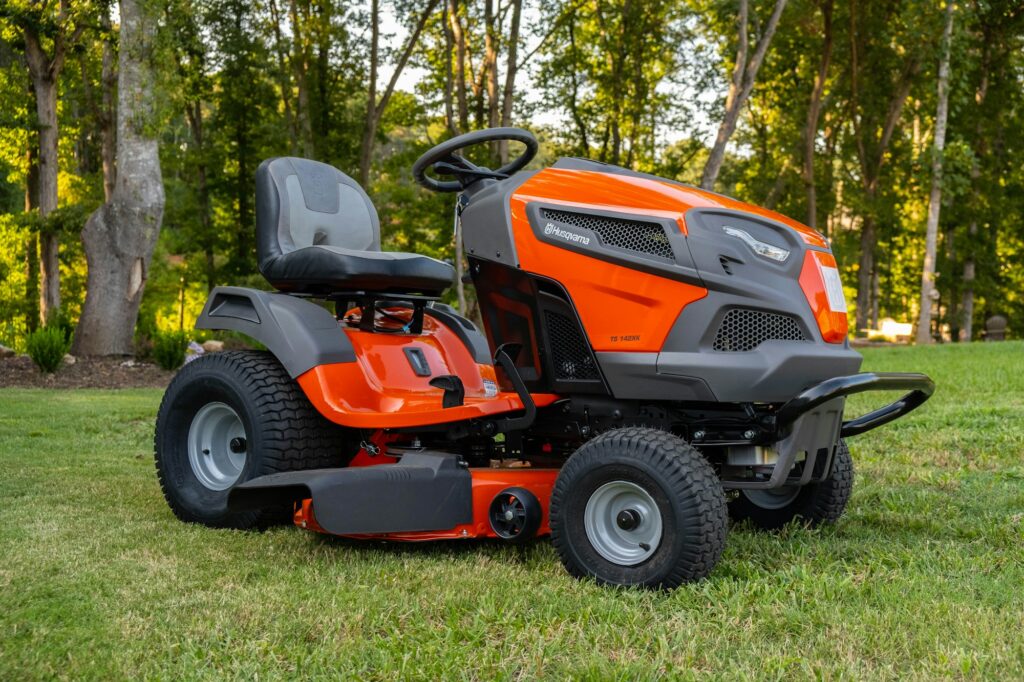
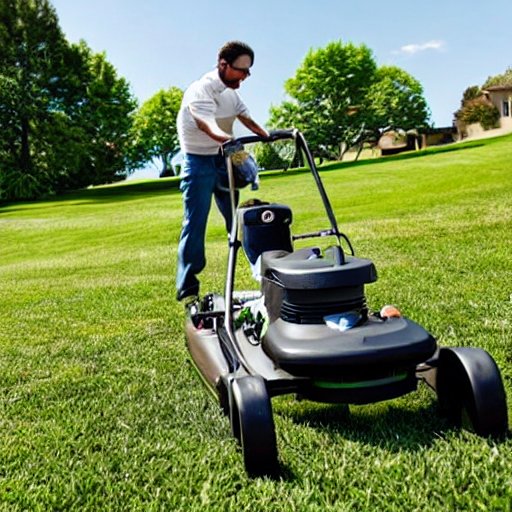
The big machines do most of the leaf work at my place. A wider deck covers more lawn per pass, and the leaves get chopped just as well as long as I keep the ground speed down.
The first thing I check is where the chips go. Both of my riders came from the dealer set up to side-discharge, which throws chopped leaves out in a strip along one side. That’s fine for a light layer, since the next pass picks them up and cuts them again. For a heavy fall, I want the pieces staying under the deck to get hit a few more times. On my zero-turn, that means bolting the mulching plate over the discharge chute. Yours may call it a mulch kit or a mulch plug, and the owner’s manual or the dealer will tell you which one fits your deck.
I mow the outside lap first with the chute pointing in, so the chips land on the lawn instead of in the beds or the street. Then I work toward the middle. On a heavy week, the second pass goes at a right angle to the first.
Keep an ear on the belt. A deck packed with leaf mush makes the deck belt work harder, and a slipping belt usually squeals right before the blades slow down. When I hear that, I stop, shut it off and clean under the deck before I go on. Cheapest check first: nine times out of ten it’s packed leaves, not a worn belt. Turns out a scraper and five minutes beat a trip to the small-engine shop.
Mow Them Dry, and Mind the Chute
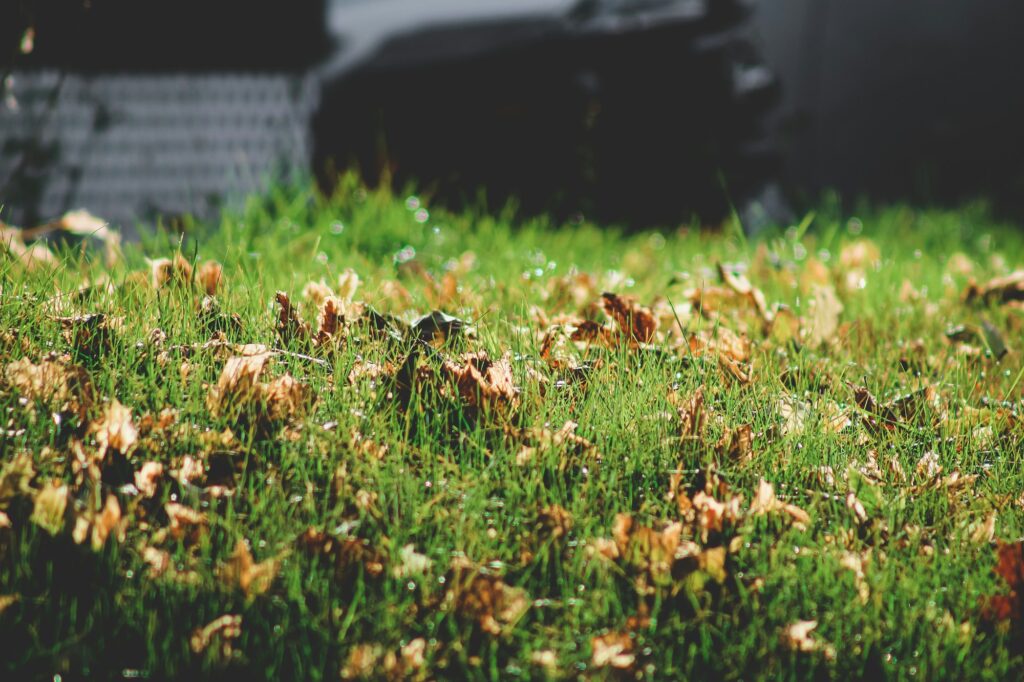
Dry leaves are the whole trick. A crisp, curled leaf shatters when the blade hits it. A wet one folds over, sticks to the underside of the deck and builds into a mat that chokes the airflow. I tried mulching after a rainy week once. It took me twice as long, the lawn ended up with soggy clumps, and I spent 20 minutes scraping the deck afterward.
So I wait for a dry afternoon. Morning dew is enough to make leaves clump, so I’d rather start after lunch, once the sun’s been on the lawn for a few hours. It’s the same idea as cutting grass, and our post on mowing grass wet or dry covers why wet days are hard on the mower too.
If the chute or the deck clogs, the engine goes off first. I wait for the blade to stop completely, pull the spark plug wire, and only then reach in with a stick or a scraper. Never a hand. A blade that’s still coasting down can still cut you.
Leaf season is also the end of the year for my push mower, so after the last leaf pass I deal with the fuel. Stale gas is the reason most of my neighbors’ mowers won’t start in April. I either run the tank dry or top it off with fresh gas and a stabilizer. Honestly, that one habit saves me more trouble than anything else I do in the fall.
Where I Still Rake

Skipping the rake doesn’t mean throwing it out. There are a few spots in my yard where the mower isn’t the answer.
The beds come first. Leaves that blow into the flower beds and around the shrubs stay there, and I add more on purpose. I run the bagger over a patch of lawn leaves and dump the chopped leaves into the beds as mulch. Whole leaves blow around and mat down into a slick layer. Chopped ones settle in and stay put.
Then there’s the drift. Every fall, one corner of my yard collects leaves a good foot deep where the wind piles them against the fence under the big maple. That’s right around MSU’s 300-pound rate, and the low-deck plots at that rate still had leaves showing on a fifth of the ground in spring. I’d rather not stare at brown patches in April, so I rake the deep part out toward thinner spots before I mow, or haul a couple of tarp loads to the compost pile.
The curb is the last one. I keep chopped leaves on my side of it. Nikolai noted that when towns vacuum leaves from the curb, the gutter’s debris and petroleum products get sucked up along with them. That’s one more reason my leaves stay on the lawn.
My Fall Leaf Routine
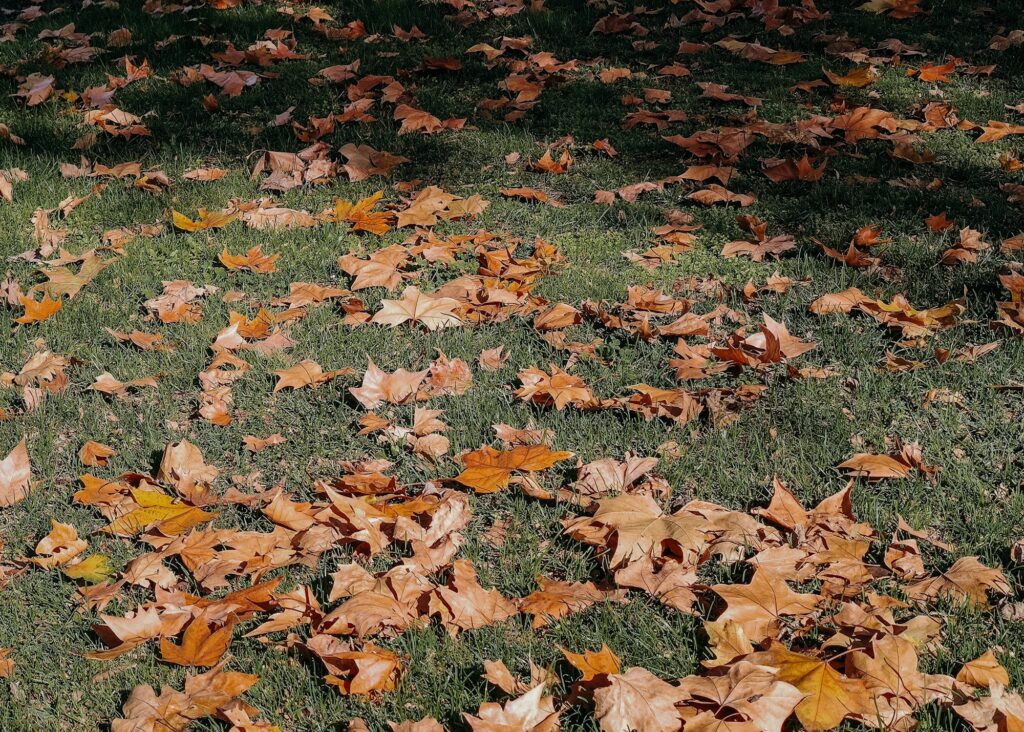
From mid-October until the trees are bare, this is the order I go in. Most weeks it adds maybe 15 minutes to a normal grass cut.
- Sharpen the blades in September, with the spark plug wire pulled, before the leaves start dropping.
- Mow whenever I can still see grass between the leaves, on a dry afternoon. That’s weekly, sometimes twice a week at the peak.
- Deck at about 3 inches, full throttle, slow ground speed. On the riders, the mulching plate goes in.
- Thick spots get a second pass at a right angle to the first.
- Drifts deeper than about a foot get raked thinner or bagged for the beds first.
- The moment the engine note changes, I stop, shut it off and clear the deck.
My finish test is simple. After a pass, if I see more grass than leaf bits, I’m done. If it still looks brown, it gets another pass. Come spring, the lawn greens up like nothing happened, and I haven’t filled a leaf bag in years.
Sources checked October 29, 2026: Michigan State University’s Turfgrass Cultural Practices Report on the leaf mulch studies at the Hancock Turfgrass Research Center, and Thomas A. Nikolai, “When Leaves Turn Into Litter,” reprinted in Hole Notes from Grounds Maintenance magazine. The deck height, the mowing schedule and the raking calls are my own habits on my own lawn, not the study’s. Your mower’s owner’s manual comes first.