
The cheapest drought tolerant landscaping idea is less lawn. Take out the grass you never use, put mulched beds of sun-loving perennials, ornamental grasses or gravel in its place, water the new plants hard for their first season, and then mostly leave them alone. You water less, you mow less, and the yard still looks like somebody cares about it.
I’m Jeff. I keep about an acre of lawn going with a riding mower, a zero-turn and an old push mower, and I fix them myself because dealer labor adds up. I’m not a landscaper. The water numbers here come from North Dakota State University Extension, the U.S. Geological Survey and the EPA’s WaterSense program, the plant list from Colorado State University Extension, and the watering schedule for new plants from the Dyck Arboretum in Kansas. The opinions about which strips of grass deserve to go are all mine.
Start With What Your Lawn Drinks

Before you rip anything out, know what the grass costs you. NDSU Extension says a lawn needs about 1 inch of water per week to stay green and growing, from you, from rain, or a mix of both. That sounds small until you turn it into gallons.
The USGS says a 1-inch rainstorm puts 27,154 gallons of water on one acre. Do the math for a yard and that’s about 623 gallons for every 1,000 square feet. So an average dry week on my acre, if I watered all of it, would run about 27,154 gallons. I don’t, and that’s the whole point of this post.
The EPA’s WaterSense page puts the national number in perspective. Residential outdoor water use in the U.S. is nearly 8 billion gallons a day, mainly for landscape irrigation, and the average household uses more water outdoors than for showering and washing clothes combined.
Want to know what your own sprinkler puts down? NDSU’s test is the cheapest check first, and I like it because it costs nothing. Set flat-bottomed cups at 5- to 10-foot intervals from the sprinkler out to the edge of its reach, and time how long it takes to collect an inch. Mine took a lot longer than I’d guessed.
Shrink the Lawn You Never Use

Walk your yard and look for grass that only exists to be mowed. On my place it was the strip between the driveway and the fence, the hump by the culvert where my zero-turn scalps every single time, and the far corner where nobody sets foot from April to October. That’s turf I watered and mowed for years for no reason at all.
Keep the lawn you actually use. The kids’ ball field, the dog’s run, the patch in front of the porch. Lawn is great to walk on, and nothing replaces it there. The idea isn’t no lawn. It’s a lawn sized to how you live.
Here’s the mower guy’s angle nobody mentions. Every awkward strip you take out is one less tight turn, one less pass with the deck hanging off a curb, and one less hour on the seat. I used to fight the slope with the deck set low and pay for it in blades. Now there’s a bed there, and the mower doesn’t go near it. If the front yard is where you want to start, my low maintenance front yard landscaping post has layouts that work around a mower.
How do you get the grass out? I’ve done it two ways. The fast way was a rented sod cutter on a Saturday, which left clean dirt and a sore back. The slow way was mowing the strip as low as the deck would go in the fall, smothering it under cardboard and a thick layer of mulch, and planting through it the next spring. The slow way was cheaper and a lot easier on me. Either way, find out where your sprinkler lines and any buried wires run before you dig, because a shovel through a sprinkler line turns a weekend project into two.
Mark the new edges with a garden hose before you cut anything. Curves you can mow along in one smooth pass beat sharp corners every time. A clean border, like a brick or concrete edge, keeps the grass from creeping back into the bed and gives your mower wheel something to ride.
Mulch Every Bed 1 to 3 Inches Deep

Mulch is what turns bare dirt into a bed that holds water. The Dyck Arboretum’s guide says to mulch new plantings with 1 to 3 inches of mulch and keep it away from the plant stems. Colorado State’s xeriscape page says the same flowers I’ll list below can be used with mulches as alternatives to turf areas, which is exactly the swap we’re making.
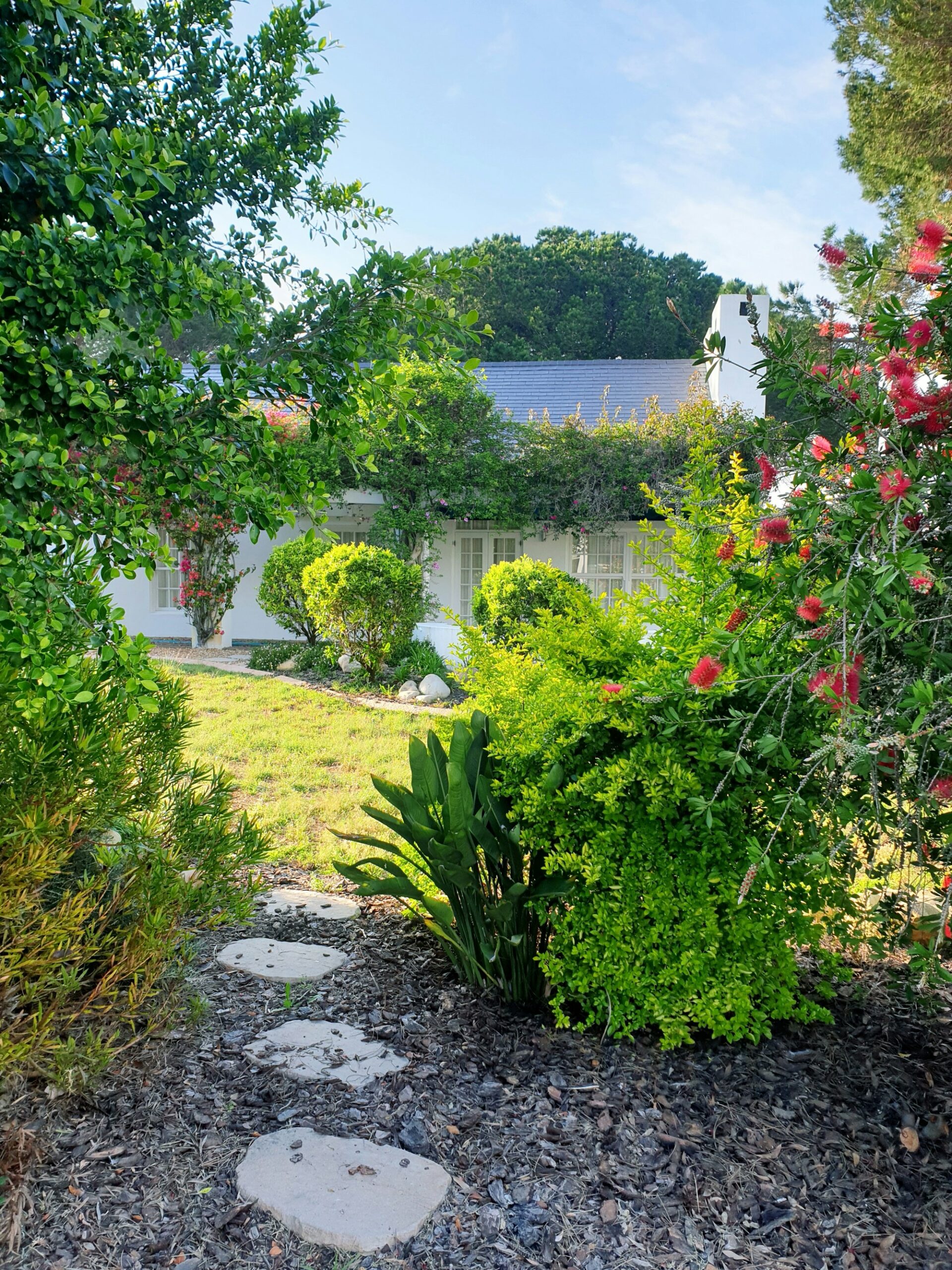
Bark or gravel? I use both. Shredded bark in the beds near the house, where I want things to look soft, and gravel in the hot strip by the driveway that bakes all afternoon. The bed in that photo shows a mix that works: gravel around the grasses and shrubs, and a drip line snaking through it to put water at the roots.
Don’t pile it against the stems. Dyck says to keep the mulch away from them, and I’ve seen enough mulch volcanoes around new shrubs to take that seriously. I leave a hand’s width of bare ground around each new plant and fill in as they grow.
Plant Sun Lovers From the Xeriscape Lists

Colorado State University Extension keeps a plain list of flowers that meet the low-water needs of xeriscaping. Western natives on it include penstemons, crimson-flowered beebalm and red-orange blanket flower. From the Great Plains it lists purple coneflower, poppy mallow and yellow black-eyed Susan. It adds New England aster, perennial flax and gayfeather, plus three from the Mediterranean: lavender, iris and red valerian.
Two catches from the same page. Most perennials and annuals need full sun, and only a few will flower in partial shade. And improve the soil before you plant, to help the roots get going. Drought tolerant does not mean “throw it in hard clay and walk away.”
That list is written for Colorado, so call your own county extension office before you buy a truckload. A plant that shrugs off a dry Denver summer can sulk in a humid one. Lavender is my test case. It loves the hot gravel strip by my driveway and hated the damp bed by the downspout, where I lost two plants in one wet spring before I moved the rest.
Ornamental Grasses in Place of Turf

If you like the look of grass but hate mowing it, ornamental grasses are the answer I keep coming back to. They fill a slope, they move in the wind, and they look good in winter when everything else is brown. On my place they went on the hump the zero-turn kept scalping, and that was the best trade I’ve made in this yard.
They do need one job a year. The old growth gets cut back so the new blades can come up clean, and the timing depends on the grass. I wrote up when to cut back ornamental grasses after getting it wrong a couple of times. A hedge trimmer does it in minutes, and it’s a lot less work than mowing the same spot every week all summer.
Plant them in mulch like the flowers, give them the same first-season watering, and keep the mower’s discharge chute pointed away. Fresh clumps don’t love a face full of clippings.
Rock and Gravel Where Nothing Wants to Grow

Some spots don’t want plants at all. The strip by the mailbox where the snowplow piles salt. The dry shade under the big maple. The corner by the AC unit. Those get gravel or river rock in my yard, and no water at all.
Rock has one big catch for a mower guy. A blade that touches gravel throws it like a slingshot. So every rock area I’ve built has a solid edge between it and the lawn, and I keep a strip of mulch or pavers between the rock and the grass so the mower never gets close. If you want ideas for the look, here’s my river rock landscaping post.
Less lawn helps the garage too. Fewer hours on the mower means less fuel bought, and less stale gas sitting in a can over the winter. That’s the cheapest maintenance I know.
Water New Plants Hard the First Year

This is where most drought tolerant beds die. The Dyck Arboretum says it plainly: “Even drought-tolerant plants need regular water until they are established!” New plants haven’t grown the roots yet that make them tough.
Its schedule is simple. For the first two weeks, water daily, depending on the weather. After the first month, you may be able to cut back to two or three times a week. In the second year, water deeply as needed, and during long dry stretches water once or twice a week.
Deep is the word that matters, for beds and for the lawn you kept. NDSU says a big gulp is better than a series of sips, because roots grow where the water is. Shallow sprinkling makes shallow roots, and those are the plants that fold first in August. On clay soil, NDSU says to water the lawn only once or twice a week.
Write the planting day on a calendar and set a reminder for those first two weeks. After that, the bed starts paying you back. Mine went from a sprinkler I moved every evening to a drip line I check once a week, and the mower spends a lot less time out of the shed.