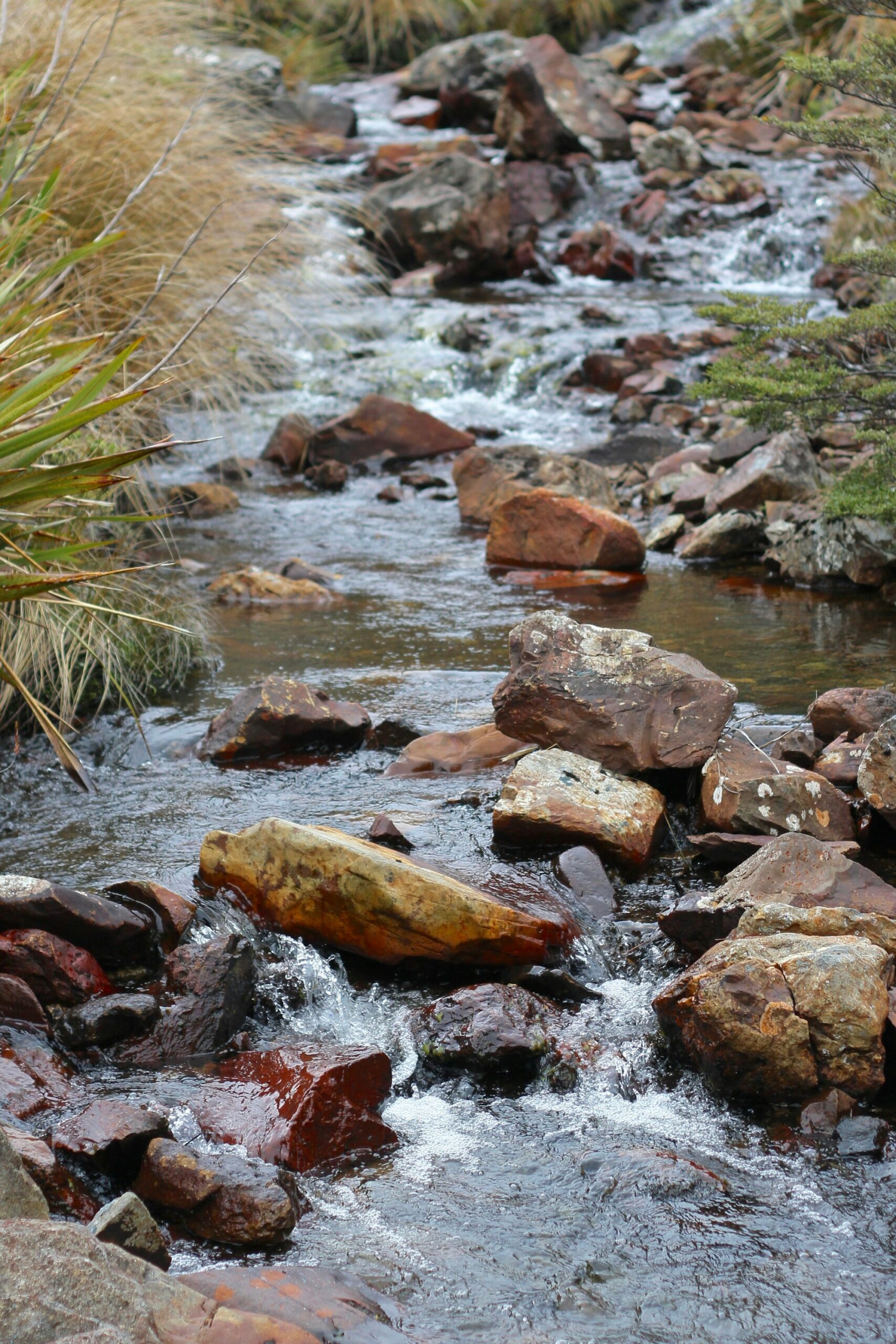

River rock sells itself in the parking lot of every landscape yard. It doesn’t rot, it doesn’t blow away, and you never buy it again the way you buy bark every spring. What the pile doesn’t tell you is that it’s heavy, it gets hot, and a stray piece of it is the hardest thing your mower blade will ever hit.
I keep about an acre of grass, so I look at every bed and border by asking one question first: what does it do to my mowing? Rock can cut the trimming down a lot. Laid wrong, it adds a chore and a hazard. Here’s how much to buy, how deep to spread it, what goes under it, and how to keep it out of the lawn, with the numbers checked against the extension services that study this stuff.
Where River Rock Works, and Where It Cooks Your Plants

Rock is a mulch, just a permanent one. The University of Nevada’s guide to landscape mulches puts the downside plainly: because they absorb heat, rock mulches raise the temperature of both the soil and the surrounding air. Arizona’s extension service goes a step further. Rock or gravel collects heat, and that pushes up the cooling costs of the house and the irrigation costs of the landscape in summer.
So the right question isn’t “do I like the look.” It’s what’s growing in the bed. Nevada’s guide points out that most vegetables, flowering annuals, ornamentals and fruit trees came from places with more rain and humidity, and they wouldn’t benefit much from a rock mulch. Desert natives and drought-tough plants handle it fine. Thirsty shrubs and anything you fuss over every week do better under wood chips or bark.
Where rock earns its place in my yard is the stuff I’d otherwise have to string-trim: the strip along a foundation, the ring around a utility box, the corner the mower deck can’t reach. If a bed is mostly bare ground and a few tough plants, rock is a good fit. If it’s a flower bed you’ll be digging in every year, skip it. Rock is miserable to dig through, and mixing soil into it ruins the look.
One more thing about the house. A wide band of rock against a south or west wall bakes all afternoon and keeps radiating after the sun goes down. That’s Arizona’s cooling-cost point in practice. A narrow strip along the foundation is fine. A whole side yard of rock against the house is a different decision.
Rock Size Sets Everything Else

River rock is sold by size range, and the size decides how deep you spread it, how much a yard of it weighs and how it behaves under your feet. The common ranges at a landscape yard are 3/4 inch, 1 to 2 inch, 1 to 3 inch and 3 to 5 inch, with bigger cobbles past that.
Small rock packs tight and covers the ground at a shallow depth. Big rock leaves gaps, so it needs a thicker layer before you stop seeing what’s under it. Weight goes up with size too: a materials calculator I checked lists 3/4 inch river rock at about 1.3 tons per cubic yard, 1 to 2 inch at 1.4, 1 to 3 inch at 1.5 and 3 to 5 inch at 1.6. Your yard’s own number is the one to use. Wet rock weighs more than dry.
For walking, round rock is the wrong pick. The stones roll under a boot, and a wheelbarrow tire sinks into them. If a path runs through the bed, put stepping stones down first and rock around them. For a bed you never walk in, 1 to 3 inch is the size most people end up with because it stays put, hides fabric well and doesn’t get kicked into the lawn as easily as the small stuff.
How Deep to Lay It

Less than you’d think. Nevada’s guide says rock mulch doesn’t go on as thick as organic mulch, although complete coverage matters, and that a layer of landscape fabric under a two inch layer of rock is enough. The point of the rock is to keep light off the soil so weed seeds don’t sprout. Any deeper than it takes to do that is just money and weight.
Two inches works for the smaller sizes. With 1 to 3 inch rock, figure on 3 inches so the gaps between the big pieces don’t show fabric. With 3 to 5 inch rock, plan on 4 inches or more. Compare that with bark, which Arizona’s extension wants at least 2 to 3 inches thick and topped up as it breaks down. Rock is thinner, but you’re stuck with whatever depth you choose, so get it right the first time.
Rake the soil smooth and slope it gently away from the house before anything goes down. Rock follows the grade under it. A low spot under the fabric becomes a puddle under the rock, and silt that washes into that puddle is where the weeds start.
Do the Math Before You Call the Yard
Landscape yards sell rock by the ton or by the cubic yard, and both start from the same three numbers: length, width and depth. Here’s the arithmetic, and it’s the cheapest check first in this whole job, because an extra ton of rock sitting on your driveway is a pain to get rid of.
- Square feet = length × width, in feet.
- Cubic feet = square feet × depth in feet (2 inches is 0.167, 3 inches is 0.25).
- Cubic yards = cubic feet ÷ 27, since there are 27 cubic feet in a cubic yard.
- Tons = cubic yards × your yard’s tons per cubic yard.
Worked through: a bed 20 feet by 10 feet is 200 square feet. At 3 inches deep that’s 50 cubic feet, or 1.85 cubic yards. With 1 to 3 inch rock at 1.5 tons a yard, that comes to about 2.78 tons. Add 10 percent for curves, low spots and spreading loss and you’d order a little over 3 tons.
Flip it around and one cubic yard covers about 162 square feet at 2 inches, 108 square feet at 3 inches and 81 square feet at 4 inches. That’s handy at the counter when the yard quotes by the yard and you measured in square feet. Measure each bed on its own, too. Treating three beds as one rectangle counts the lawn between them.
Ask about a minimum delivery before you settle on bulk. Some yards won’t send a truck for less than a couple of tons. For a small tree ring, bagged rock from the home center is often cheaper once the delivery fee is in. Those bags are usually half a cubic foot, so 1.85 cubic yards of rock would be about a hundred bags. That’s where bulk wins.
What Goes Under It: Fabric, Never Plastic
This is the one where the experts don’t agree, so here’s the disagreement as it stands. Nevada’s guide says that for the best weed control, a layer of landscape fabric (not sheet plastic) goes on the soil before the rocks. Utah State’s mulch fact sheet likes woven fabric too: it suppresses weeds, lets water and air through, and resists punctures and tears when rock goes on top.
Arizona’s extension agent sees it differently. Soil blows in on top of the fabric, weeds start growing in that soil after a few years, and weed seeds blow into gravel and take hold even with fabric underneath. The sheet’s advice for home landscapes is to skip the fabric, pull weeds early and fill the space with plants that suit the site.
Where they all agree: no black plastic. Arizona’s sheet says it repels water and cuts the oxygen in the soil, and Nevada names sheet plastic specifically as the wrong thing to put under rock. If you’re tearing out an old rock bed and find plastic under it, that’s probably why the plants in it never did well.
My own take: for a permanent strip that’s mostly rock and a few plants, woven fabric is worth it. Overlap the seams by several inches, pin them down and cut an X for each plant. For a bed you’ll keep planting into, skip it and accept a little more weeding.
Edge It, or You’ll Be Mowing Rock

Rock walks. Kids kick it, dogs dig it, rain pushes it and the string trimmer flings it, and every piece that leaves the bed lands in the grass you’re about to mow. An edge stops most of that. Steel or aluminum edging, a row of pavers set flush with the lawn, or a poured concrete curb all work. I’d spend the money on metal before thin plastic roll edging.
Thin plastic is cheap for a reason. Frost lifts it, the trimmer chews it, and in a couple of years it’s a wavy line that holds nothing.
Set the edge so its top sits a little above the rock and level with the soil on the lawn side. Flush with the soil means a mower wheel can roll right along it and you don’t need the trimmer on that line at all. A mowing strip like that is the single best thing you can do for a rock bed if you hate trimming as much as I do. I covered the same idea for fences in the post on fence line landscaping ideas.

Keep the rock a bit below the top of the edging, not heaped against it. Rock piled to the rim spills over the first time someone steps on it.
Mowing Next to a Rock Bed
Here’s the part that matters to me most. Virginia Tech’s extension says a rotary mower blade turns at 2,000 to 4,000 revolutions per minute, and the blade tip, or debris thrown off it, can reach 100 to 200 miles per hour. A river rock is a smooth, heavy stone at that speed. On bigger tractor-pulled rotary cutters, LSU AgCenter says stones and other debris can be thrown more than 300 feet.
Virginia Tech’s first rules are the ones that apply here: remove all loose objects from the area before mowing, and wear safety glasses or goggles where loose objects are around. With a rock bed, that means a quick walk along the edge before you start, flicking any strays back into the bed. It takes a minute.
That walk is the cheapest check first, and honestly it’s the one everybody skips (me included, on a hot afternoon).
Then mow so the discharge points away from the rock. On the pass along the bed, the chute should throw into the lawn, never toward the stones, the house or the street. With my zero-turn that means running the bed edge with the bed on the side away from the chute, then turning around for the next pass. Keep the deflector down. It’s there for exactly this.
If you do hit a rock (you’ll hear it), stop, shut the engine off and pull the spark plug wire before you look under the deck. A rock can nick, dull or bend a blade. A bent one shakes the whole machine, and if the mower vibrates after a hit, that’s the first place to look, before you blame a deck that vibrates on bearings or the belt. A nicked blade can be filed and balanced. A bent one gets replaced, and the blade bolt goes back to the torque spec in the owner’s manual. If the spindle shaft itself took the hit, that’s a small-engine shop job.
Keeping It Clean Year After Year

Rock is called permanent, but Nevada’s guide is honest about it: rock mulches are hot and heavy, they look shabby once trash gets caught in them, weeds that do come up between the stones are hard to pull, and rocks do break down over time and need refreshing. It also notes that a mulch of large stones can give shelter to animals you’d rather not have.
Leaves are the main job. If they sit in rock all winter they rot down into a layer of soil, and that soil is where the next crop of weeds grows. A leaf blower on a low setting clears them without moving much rock. A rake drags the stones out. Under trees, that’s reason enough to use bark instead. I went through the options in what kind of mulch is best for landscaping.

And don’t mix the two. Nevada’s guide says it’s generally not a good idea to put a temporary mulch like compost on top of a permanent one like rock, and that most beds do best with one kind, either organic or inorganic. Compost on rock washes down between the stones and feeds weeds. Rock on compost sinks in, and you can never get the compost out to replace it.
Once a year, pull the few weeds that made it, top up the thin spots with a few bags and straighten any edging that heaved. A 1 to 3 inch rock bed laid over fabric at 3 inches with a steel edge is about as close to no work as anything in the yard gets. Just keep it out of the grass.