
The shrubs that keep a front yard looking sharp with one trim a year are the ones that stop growing at the size you want: littleleaf boxwood, dwarf yaupon holly, inkberry, Little Lime hydrangea, Meyer lilac and Blue Star juniper. Pick by your winters and your sun, plant them far enough apart for their full width, and the one trim becomes a short job instead of a whole Saturday.
I keep about an acre, and the beds along the front of the house get the least of my time, on purpose. Most of the trimming people do out there isn’t shaping at all. It’s fighting a shrub that wants to be twice the size of the spot it was planted in. Choose one that’s already the right size when it’s grown, and most of that work goes away.
Start With the Mature Size, Not the Pot

A shrub in a nursery pot tells you nothing about the bed in five years. The tag does, if you read the height and the width and believe them. I read the width first now (the height is the number everyone looks at, and it’s the width that eats the bed). A shrub that tops out at 4 feet under a 3-foot window will need cutting every year for the rest of its life. One that tops out at 3 feet won’t.
Measure the bed from the foundation to the lawn, and measure the height under the lowest window. Then pick a shrub whose grown width fits in that bed with a little to spare. I’d rather plant small and wait than plant big and cut. A wide shrub needs a deep bed. Meyer lilac, for example, grows 4 to 8 feet tall but 6 to 10 feet wide, so it needs more bed than it looks like it does.
For spacing, I set them about one grown width apart, center to center. The bed looks a bit thin for a couple of seasons. That’s the price of never having to shear them into a wall later.
Picks for Cold-Winter Yards

If your winters are hard, start with these. All four are listed for colder zones than boxwood or dwarf yaupon.
Little Lime hydrangea. A dwarf panicle hydrangea that stays 3 to 5 feet tall, with lime-green flowers that turn white and then rose and red as fall comes. The Tree Center lists it as hardy down to minus 40 degrees and fine right through zone 8, and it takes sun or part shade. The big draw for a one-trim yard is that panicle hydrangeas bloom on new growth, so a cut in late winter doesn’t cost you the summer’s flowers.
Meyer lilac. A compact lilac that’s wider than it’s tall, with fragrant pale lilac flowers. NC State lists it for zones 3 through 7 and notes it has more mildew resistance than most lilacs. It wants full sun but tolerates some shade. Give it the width it needs and it barely needs cutting at all.
Blue Star juniper. A low, silvery-blue evergreen that grows 1 to 3 feet tall and slowly. NC State lists it for zones 4 through 8, full sun, and says it usually needs no pruning. It’s my first choice for the strip under a low window or along a walk.
Inkberry. An evergreen holly native to the Southeast, with glossy, dark green leaves, listed for zones 4 through 11. The species gets 5 to 10 feet tall, so for a foundation bed look for one of the compact cultivars at the garden center and check its tag. It only needs pruning if you’re keeping it as a hedge.
Picks for Warm-Winter Yards


South of the snow line, two classics carry most front yards, and both are built for neat.
Dwarf yaupon holly. This is the one I’d plant first in a warm yard. NC State lists it at 3 to 5 feet tall and 3 to 6 feet wide, for zones 7 through 9, and says it’s resistant to root rot, drought, salt spray and deer browsing. It spreads wider than it is tall and can take heavy pruning, which is why you see it clipped into balls and low hedges all over the South. It’s listed as fast-growing, so it’s the one shrub here that may want a second light pass some years.
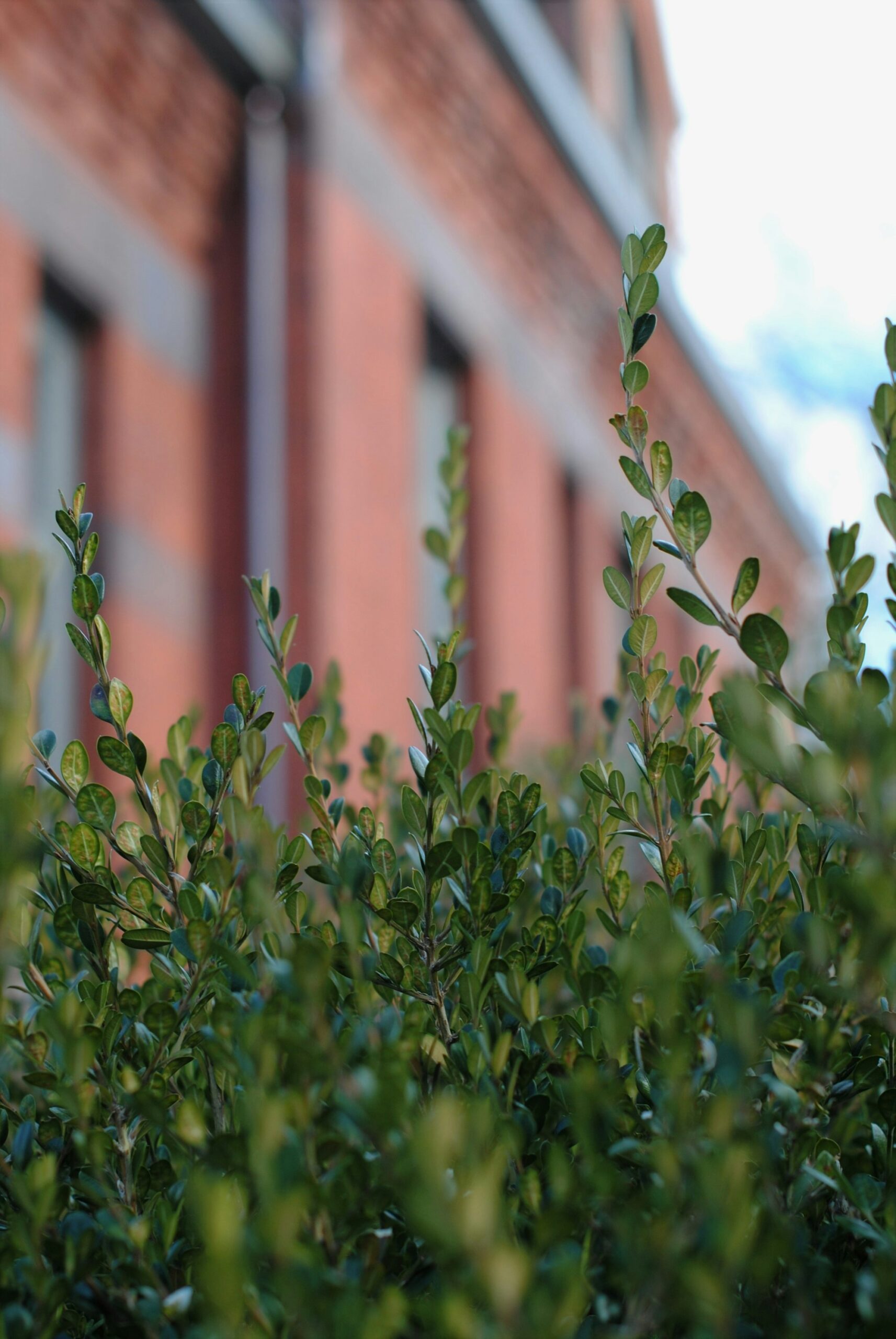
Littleleaf boxwood. Small leaves, slow growth, 3 to 4 feet tall and 2 to 4 feet wide, zones 6 through 9. NC State says it prunes exceptionally well and is resistant to damage by rabbits and deer. That slow growth is the whole reason it works in a one-trim yard. A boxwood that’s shaped once in late spring still looks shaped in the fall.
Inkberry works in warm yards too, since its range runs all the way to zone 11, and so does Little Lime up through zone 8.
For the Shady Side of the House

Most front yards have one side that only gets a few hours of sun. NC State lists littleleaf boxwood, inkberry, dwarf yaupon and Meyer lilac for partial shade, which it defines as direct sun for only part of the day, 2 to 6 hours. Little Lime handles part shade too.
Keep Blue Star juniper on the sunny side, since it’s listed for full sun only. Meyer lilac will tolerate some shade, but NC State says it prefers full sun, so if the flowers are the point, give it your sunniest spot.
Deer matter here as much as sun. Boxwood and dwarf yaupon are listed as resistant to deer. Inkberry’s leaves get eaten by deer and rabbits, and panicle hydrangeas may be damaged by deer, so if you see deer in the yard at dusk, lean on the first two.
When to Make the One Trim

One trim a year only works if it’s at the right time. Cut a lilac in fall and you’ve cut off next spring’s flowers. Cut boxwood before a late frost and the new growth burns.
The rule behind most of it is simple. NC State’s pruning guide splits flowering shrubs by where they bloom. Shrubs that bloom on last year’s wood get pruned right after they flower. Shrubs that bloom on new wood, like panicle hydrangeas, get pruned in late winter or early spring. Lilacs bloom on old wood, and the New York Botanical Garden’s advice is to prune them immediately after flowering, so the new growth has time to set next year’s buds.
For the evergreens, NC State says to hold off on littleleaf boxwood until there’s no more chance of a late spring frost, and to prune inkberry in early spring just before new growth starts. Blue Star juniper usually gets nothing at all.
Shape It Wider at the Bottom


When you shear a hedge or a row of boxwood, leave the bottom a bit wider than the top. NC State’s pruning guide gives the reason: it lets light reach the lower limbs and keeps them full and green. Cut it straight up and down, or narrower at the base, and the bottom goes bare in a few years, which is the opposite of curb appeal.
The same guide suggests some hand thinning every three to five years, with hand pruners, to open up the inside of a sheared shrub. That’s a short job if the shrub is the right size to begin with.
When I shear, I tilt the trimmer so the face of the hedge leans in a little toward the top (just a few degrees is plenty). For the trimmer itself, the cheapest check first is the blade. A dull or gummed-up blade tears leaves instead of cutting them, and the torn edges brown off. Clean it after each use and oil it the way the owner’s manual says. If the shrubs are tall or set back behind a wide bed, a long-reach hedge trimmer saves a lot of leaning. If they’ve been let go for a few years and the stems are thick, look at a hedge trimmer built for thick branches before you burn up a light one.
Leave Room for the Mower

A bed that crowds the lawn costs you time every week, not once a year. When a shrub grows out past the edge of its bed, you end up stopping the mower, ducking branches and finishing the edge with a string trimmer.
With my zero-turn, the goal is to run the deck right along the bed edge in one pass. That only works if the shrubs’ full width stays inside the mulch with a few inches to spare. So when you plant, put the center of the shrub at least half its grown width plus a few inches back from the lawn edge. A 4-foot-wide boxwood goes 2 feet and change in from the edge, not 1 foot.
A clean edge helps too (and it saves a lot of mulch). A cut edge or a simple border keeps the grass out of the bed and the mulch out of the lawn, and it makes even a plain row of shrubs look finished from the street.
The Ones I’d Skip

Japanese spirea. It’s sold everywhere, it’s cheap and it flowers, but NC State lists it as rapid-growing and high-maintenance, and notes it’s listed as invasive in Virginia, Georgia, South Carolina, Tennessee, Kentucky and other places, and classified as invasive by the NC Invasive Plant Council. That’s not a one-trim shrub, and it doesn’t stay in its bed.
Common boxwood in a small bed. The full-size species can slowly reach 15 to 20 feet tall at maturity, according to NC State. It can be kept much shorter by pruning, but that’s a shrub you’ll be cutting back every year. For a foundation bed, littleleaf boxwood or a dwarf cultivar is the better buy.
A full-size panicle hydrangea under a window. The species runs 8 to 25 feet tall. It’s a great plant at the back of a yard. Under a window it’s a yearly fight, which is exactly why the dwarf ones like Little Lime exist.
My Short List
If I were planting a front bed from scratch, I’d anchor the corners with something evergreen, either dwarf yaupon in a warm yard or a compact inkberry in a cold one. Then I’d run littleleaf boxwood or Blue Star juniper under the windows and put one Little Lime or Meyer lilac where it’s seen from the street.
That mix gives you green all winter, flowers in season, and one short trim a year, timed for each plant. Most of the work happens the day you plant, when you choose the size, and I’ll take that trade every time.