
A used riding mower is worth what the same model sells for new today, minus what its hours, its condition and the season take off. There’s no free Kelley Blue Book for lawn tractors that you can look up in two minutes. So you build the number yourself from today’s new price and from what the same machines actually sold for near you.
I keep about an acre of grass, a riding mower, my zero-turn, an old push mower and a snowblower running, and I’ve bought used and sold used. I’m not a dealer and I’m not a technician. What’s below is how I price one, using real numbers from a John Deere dealer’s flyer, TractorData’s records and the warranty on the sticker. I’ll show my math so you can redo it for your own machine.
There Is a Blue Book. You Just Can’t Easily See It

Dealers and lenders do have a price guide. It’s called the IronGuides Outdoor Power Equipment Guide, from Iron Solutions. Its own page says its values come from dealer sales reports, and that each entry gives an average resale value and an “as is” value, the number a lender will loan against. It covers models from 1967 to 2020 from 70 manufacturers.
It’s a paid book with a subscription for the online version, and it’s built for the dealer, not for you in your driveway. Those “free mower value calculator” sites that pop up in a search are mostly thin pages that guess. So I don’t trust any of them. I trust the new price and the sold listings.
Start From Today’s New Price, Not the Old Sticker

The old rule you’ll hear is that a used rider is worth about half its retail price. Bob Vila said exactly that in an article last updated back in 2014. Fine as far as it goes. The trouble is the word “retail.” Retail when?
Take the John Deere S120, a 22-horsepower V-twin lawn tractor with a 42-inch deck, built in Greeneville, Tennessee. TractorData lists its original price as $2,099 in 2021. Tractor Central’s fall 2026 flyer lists the 2026 S120 at $2,999, on sale for $2,799. That’s a big jump in five years.
So “half of retail” on a 2021 S120 is either about $1,050 or about $1,500, depending on which sticker you halve. The buyer will reach for the old one. Don’t let them. Nobody can buy that machine new at $2,099 today. What the buyer’s really choosing between is your used tractor and a new one at today’s price, so today’s price is the honest anchor.
Hours Tell You More Than the Year

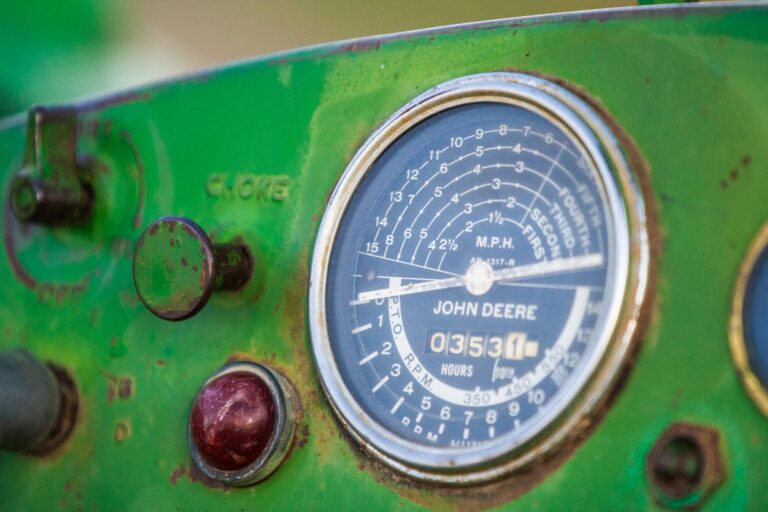
Two mowers from the same year can have lived very different lives. One mowed a quarter acre for a retired couple. The other cut three neighbors’ lawns for cash. The hour meter, if the machine has one, tells you which.
Here’s a yardstick I like, because it comes from the people who built the thing. That same flyer gives the S120 a 2-year/120-hour bumper-to-bumper warranty. Deere’s X350 gets 4 years or 300 hours. Do the division and John Deere is planning on roughly 60 hours a year for the S120 and 75 a year for the X350. That’s my reading of their warranty, not a number they publish, but it’s a fair picture of a normal homeowner season.
So a 2021 S120 with five seasons on it should show somewhere around 300 hours. At 100 it was babied, and I’d pay a bit more. At 600 it worked hard, and I’d pay less, though Bob Vila’s piece makes a fair point: don’t be scared off by hours alone, because mower engines tend to last. What wrecks an engine is skipped oil changes and stale gas, not a high number on the meter. Ask for the receipts. For more on that, here’s our take on how long a Briggs and Stratton engine lasts.
Brand Matters, and So Does the Dealer Down the Road

Some brands hold value better, and the reason isn’t magic. It’s parts. A buyer will pay more for a tractor when there’s a dealer twenty minutes away who stocks the belt, the blades and the filters. A brand with no service in your area is a brand nobody wants to own when it breaks.
Engine matters too. In my experience a V-twin is easier to sell than a single-cylinder in the same size class, and a Kohler, Kawasaki or Briggs that a local small-engine shop already knows how to fix is a selling point. If you’re curious how the three stack up, we compared Briggs and Stratton vs Kohler vs Kawasaki.
Condition Knocks Off Real Money

Once you’ve got a starting number, walk around the machine like a buyer would. Bob Vila’s list is a good one: belts, battery and wiring, tires for cracks and dry rot, blades and whether the deck’s level, and fluid levels, with an eye out for leaks.
My rule is simple. Every repair the buyer can spot comes off the price at what it’ll cost them, parts and labor, at the dealer. A cracked belt, a battery that won’t hold a charge, two dry-rotted rear tires, a deck that shakes. Price each one, add them up, take the total off. Check the cheapest stuff first, too. A tractor that “runs rough” is often just old gas, and selling it that way leaves money on the table. If the deck shakes, read why a mower deck vibrates before you knock anything off. And if the tires look tired, here’s how long mower tires last.
On the plus side, a clean deck, fresh oil, a sharp blade and the owner’s manual in a zip bag all make a buyer trust you. None of that costs much. All of it shows.
The Season Moves the Price

Nobody’s shopping for a lawn tractor at the end of October except bargain hunters. And this fall the dealers are competing with you. That Tractor Central flyer had $200 off the new S120, good through November 1, 2026, plus financing deals. A buyer who can get a new one with a warranty at $2,799 isn’t paying $2,000 for your used one.
If you can wait, sell in spring, when the grass is growing and everyone’s mower just failed to start. If you’re buying, now’s your time. Just plan to change the oil, the plug and the gas before you mow with it, because in my experience stale gas over winter is the most common reason a used mower won’t start in April. Here’s how long gas can sit in a mower.
Check What Sold, Not What’s Listed

Asking prices are wishes. Sold prices are facts. On eBay, filter a search for your exact model by sold listings and you’ll see what people actually paid. Facebook Marketplace and Craigslist only show asks, but you can still learn something: a listing that’s been up for three weeks is priced too high.
Match the model, the deck size and the year within a couple of years either way. Stay inside a couple of hours’ drive, because nobody hauls a lawn tractor across three states for a deal. And look at dealer used lots too. They price with the paid guide in hand, so their used price, minus the warranty and prep they add, is a good ceiling for a private sale. Our list of used mowers under $500 shows what the bottom of the market looks like.
Write the Listing the Way a Buyer Reads It

If you’re the seller, your listing does half the pricing for you. Put the model number in the title, not just “John Deere riding mower.” A buyer searching “S120” will never see a listing that only says “green tractor, runs good.”
Then answer the questions before they’re asked. The year. The hours, with a clear photo of the meter if it has one. The deck size. When the oil, the filter and the blades were last done. Whether it’s been stored inside. Mention what’s wrong too, honestly. A buyer who finds a problem you didn’t mention assumes there are three more, and the offer drops by more than the fix would ever cost.
Take photos in daylight, from all four sides, plus one under the deck. Wash it first. I know, it’s a mower, it’s going to get dirty again. Still, a clean deck tells a buyer somebody cared, and a deck caked with old grass tells them nobody looked under there in years.
Last thing. Start it cold when the buyer shows up, not after you’ve run it for ten minutes. A smart buyer will ask for that anyway. An engine that starts cold on the first pull of the key, idles smooth and doesn’t blow blue smoke is worth more than any sentence you can write in a listing.
My Worked Example
Here’s how I’d price a 2021 S120 with about 300 hours, good tires and a belt that’s cracking. Start at today’s list of $2,999. Half of that is about $1,500. The hours are normal for five seasons, so no change. The belt and the labor to put it on come off, so check what your dealer charges for both. It’s fall, so I’d ask a bit under that number and expect to come down. In April I’d ask a bit over it.
That’s not a book value. It’s a number you can defend, which is what you need when a buyer’s standing in your driveway with cash and an opinion.