
The best sloped backyard landscaping keeps grass on the flat ground and replaces whatever’s too steep to mow safely. Measure the slope first. Past about 27 percent, or 15 degrees, I’d stop calling it lawn. Plant it or terrace it. That’s the strip eating your Saturday, and it’s also the strip most likely to put a mower on its side.
I’ve got about an acre, a riding mower, a zero-turn and an old push mower, so I’ve thought about this more than most people should. I’m not a landscape designer and I’m not an engineer. The plant lists below come from Purdue and NC State, the slope limits come from UGA Extension and Toro, and the opinions are mine. I’ll tell you which is which.
Measure the Slope Before You Buy a Single Plant

Cheapest check first. This one costs you nothing but 10 minutes and a helper. UGA Extension’s method is simple: measure the drop over a 10-foot distance, divide that by 10 feet, and multiply by 100. Hold a straight board level out from the high side, then measure from the end of it down to the ground. If the ground falls 3 feet over 10 feet, you’ve got a 30 percent slope.
Now compare that number to the limits. UGA says riding mowers are unsafe on ground steeper than 27 percent. Toro says never to drive a zero-turn on a slope greater than 15 degrees, and those two numbers agree, since 15 degrees works out to about 27 percent. UGA puts push mowers at up to 20 degrees, which is about 36 percent.
Those are ceilings, not targets. Turns out the number that counts is the one in the owner’s manual for your machine, and some makers’ limits run lower. I’ve got a longer write-up on how steep a zero-turn can go if you’re close to the line. And a slope that feels fine in dry July is a different slope after rain.
Find the Grass That Costs You the Most Time

Walk the yard with a handful of flags before you plan anything. Mark every spot where the deck scalps, where you’ve got to back up and try again, or where you tense up on the turn. Those are your candidates. NC State’s advice on hard-to-mow spaces is the same idea: get rid of them and you cut both the time and the expense of keeping them up.
While you’re out there, check the light. NC State says turf needs at least four hours of sun a day. A shady bank under trees is a bad place for grass even if it’s a safe place to mow, so it can go first.
Here’s what the change is worth. Say your bank is 100 feet long and 20 feet deep, which is 2,000 square feet. A 21-inch push mower at 3 miles per hour covers that in about 4 minutes on paper, but nobody mows a bank at full speed. Double it for the turns and the slow going and you’re near 9 minutes a mow. Over 30 mows a season, that’s 4.5 hours, and they’re the worst 4.5 hours of your year. (That’s my rough sum for one example yard.) Run your own numbers in the lawn size and mowing time calculator.
Ground Covers That Hold a Bank

For a bank you can still walk on, ground cover is where I’d start. Purdue’s horticulture team says slopes need plants that establish quickly, and that started plants often cover faster than seed, though seed’s cheaper. Their slope list includes ajuga and catmint. Sedum and daylily are on there too. For shade, they mark hosta and Christmas fern. Purdue’s in Indiana, so check any plant against your own zone, and ask your county extension office what’s invasive where you live.
Be honest about the trade. Garden writer Neil Sperry points out that the lowest-maintenance ground cover is usually turfgrass, and that a ground cover bed needs some weeding and watering for its first year or two. So you aren’t getting rid of the work. You’re moving it from every week for 7 months to a few sessions a year, on your feet, with no machine that can tip over. I’d take that deal.
Put your plants in staggered rows so water can’t run straight down between them. Purdue also suggests a temporary living mulch, such as annual rye or wheat, to protect the soil until the real plants fill in.
Grasses and Shrubs for the Steep Part

Past the point where you’d want to stand on it, go bigger. NC State says native shrubs and ornamental grasses can go on steep slopes that are often too dangerous to mow. Purdue calls a mixed planting the best strategy for holding a slope, if you’ve got the space. That makes sense to me. I’d rather have 10 kinds of plant than bet the whole bank on one.
From Purdue’s list, little bluestem and switchgrass are the grasses I’d look at first. For low shrubs, they name diervilla and snowberry. Some nurseries sell blends made for slopes, which saves you the guessing.
You’ll still have a job or two a year here. Honestly, it’s nothing. Ornamental grasses want cutting back, and a string trimmer’s fine for that. Mulch the bare spots until the plants close in, and use something that knits together, since nuggets roll downhill. My post on the best mulch for landscaping goes through the options.
Terraces Turn One Bad Slope Into Usable Ground

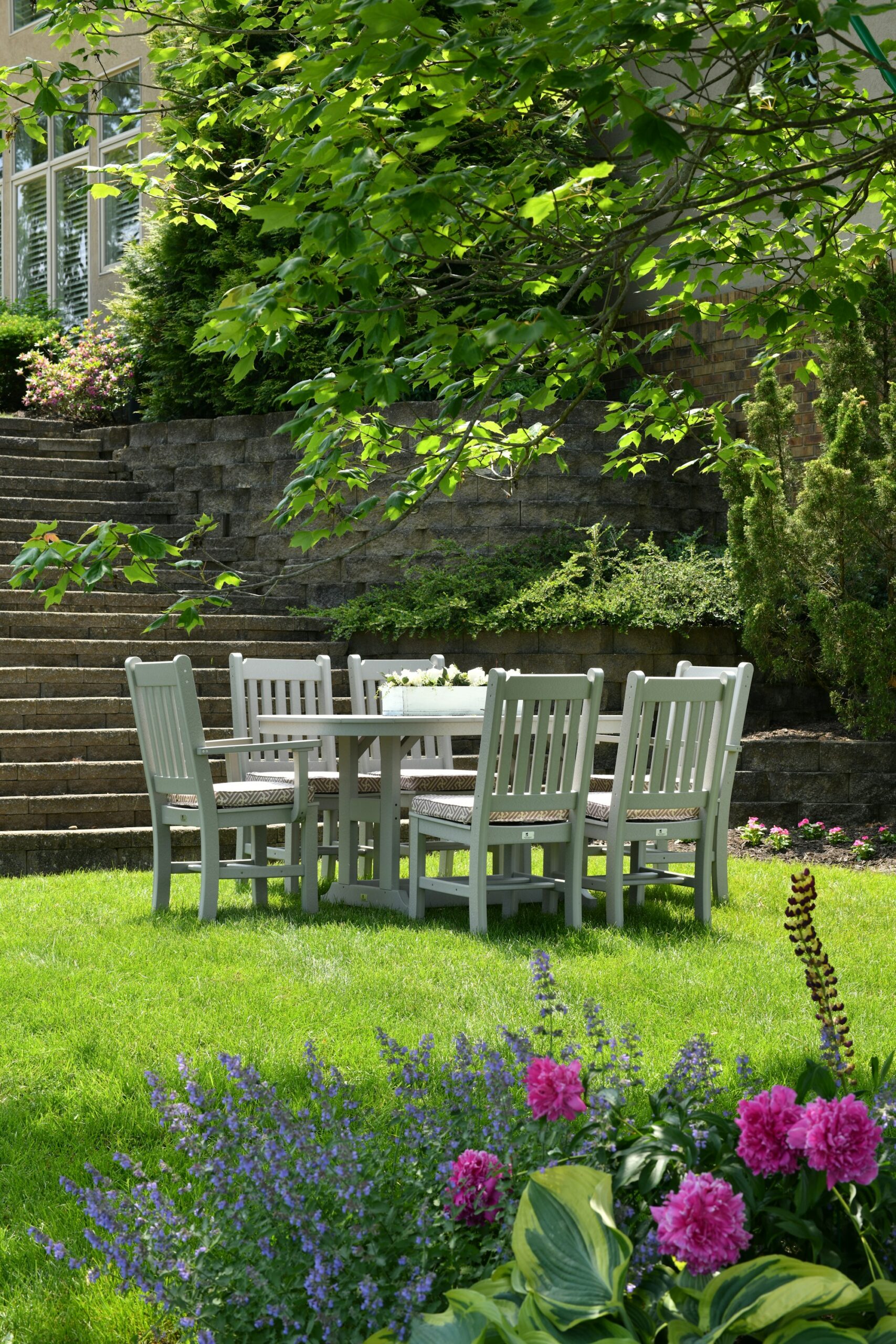
Purdue lists terracing, boulders and retaining walls as options when plants alone won’t do it. A terrace swaps one long slope for a couple of flat steps. You can use each step for a bed or a patio, or a strip of lawn small enough for a push mower. It’s the fix that gives you ground back, and it’s the one that costs real money.
This is also where I stop giving DIY advice. A wall that fails takes the yard with it. Rules change by county, but 4 feet is a common line. Douglas County, Colorado requires a permit and an engineered design for a wall over 4 feet, measured from the bottom of the footing. Pierce County, Washington doesn’t require a permit up to 4 feet unless the wall carries a surcharge, meaning extra load like a driveway or a slope above it. Stacking two short walls isn’t a loophole either. Douglas County treats two 4-foot walls set 4 feet apart as one 8-foot wall.
So call your building department before you buy block. Then call 811, which is free. Retaining walls count as digging, and the notice runs from 2 to 3 working days in states like Texas and Virginia. If the wall’s anywhere near your foundation or driveway, hire an engineer. (I don’t care how good your weekend project videos are.)
Keep a Way Up and a Way Down

A slope you’ve planted still has to be crossed. NC State’s suggestion for high-traffic spots is mulch, gravel or stepping stones instead of worn-out grass. Stone steps look great, and they’re also how you get a bad knee, so think about what you’re carrying. A path that angles across the hill at an easy grade beats stairs if there’s a wheelbarrow in your life.
Here’s the one people forget. Your lower lawn still needs a mower, and my zero-turn doesn’t fly. Before you plant the last gentle route down, measure the deck with the chute down and leave a path at least that wide, plus a few inches, on ground inside your machine’s limit. If there’s no safe route, keep a push mower at the bottom or budget for someone else to cut it. Check how much gravel a path takes before you price it, since it’s usually more than you’d guess.
Deal With the Water Before It Deals With You

Every slope is a water problem with grass on it. Every one. Toronto Master Gardeners call erosion a key consideration on steep ground, and new soil on a bank is about as weak as it’ll ever be. So look at where the water comes from first. If a downspout or a neighbor’s yard is feeding your bank, fix that before you plant, or you’ll be replanting by April.
For a soggy bottom, NC State suggests plants that tolerate wet feet, like mosses, or a rain garden. On the face of the slope, I’d rake shallow grooves across the hill, not down it, so roots and mulch have something to grab. On a really steep bank, you can plant through slits in a biodegradable erosion blanket, which holds the soil while the roots take over.
Water new plants through their first summer. A dry slope sheds water fast, so a slow soak beats a quick spray every time. If you’ve got a soaker hose, run it across the hill, and give it a good 30 minutes before you judge it.
What I’d Do First

Start small, and start with the strip you hate most. You don’t have to convert the whole yard this year, and you shouldn’t. Measure it and flag it, then take out the steepest 500 square feet first. That’s a weekend or two of work, and you’ll know by next summer how much time you’ve got back. If you liked that result, do the next piece, and work your way along the bank a strip at a time.
Keep whatever grass you can mow safely, because it’s the cheapest ground cover you’ll ever own. If the flat part of your yard could use the same treatment, the ideas in low-maintenance front yard landscaping carry over. And if you’re still not sure a slope is safe to mow, leave the machine in the garage until you’ve read the owner’s manual. A slope doesn’t care how long you’ve been mowing it.