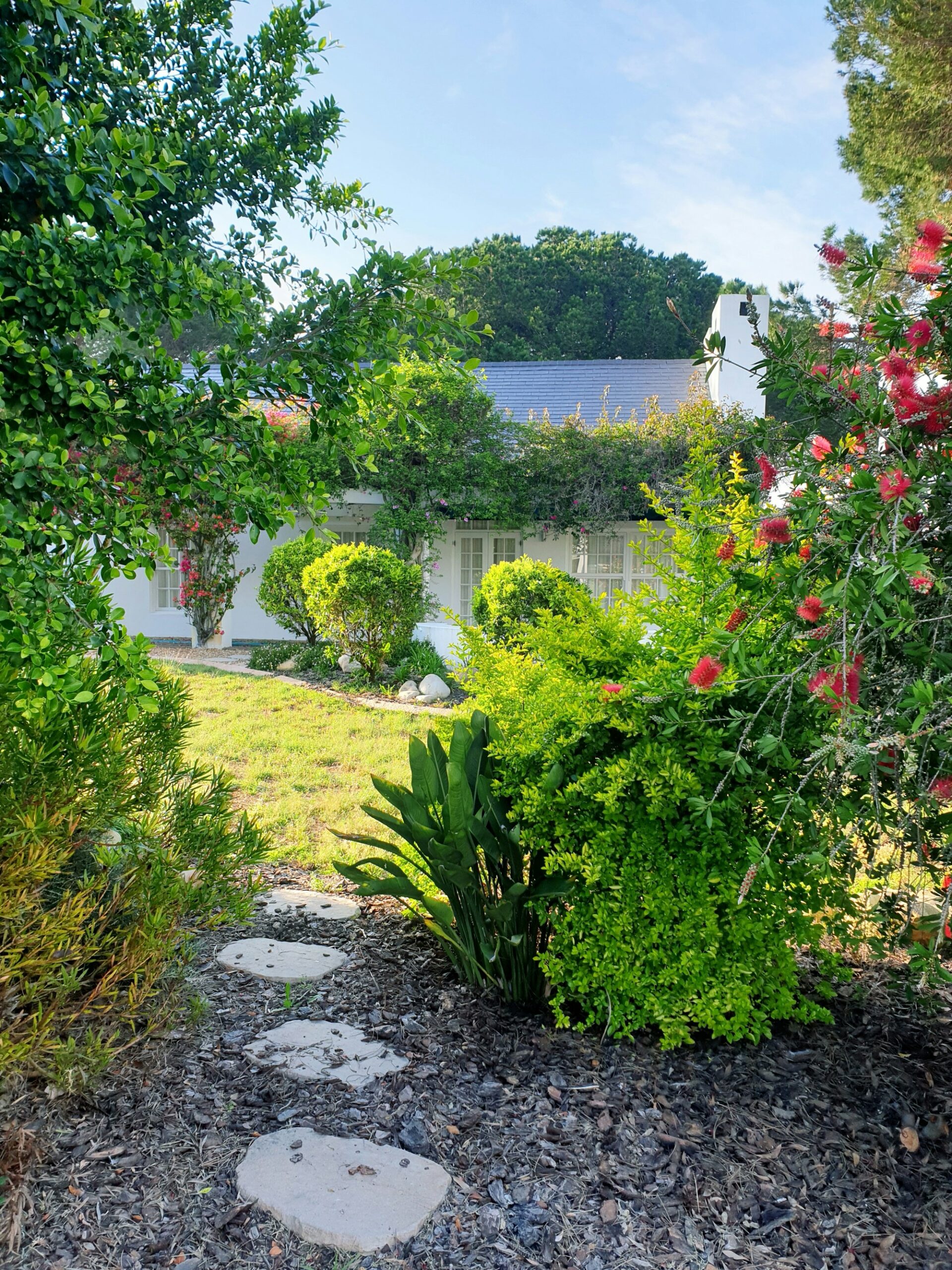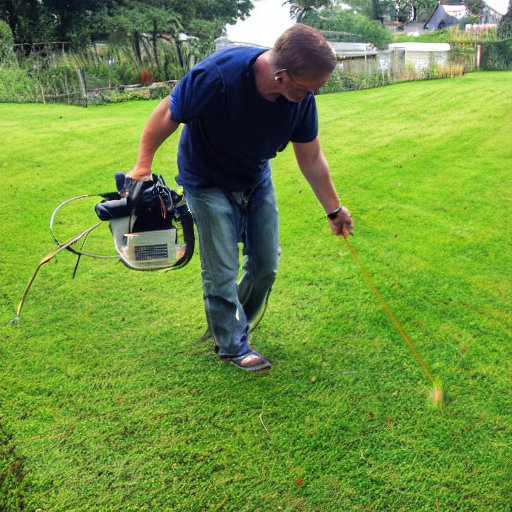

The best flower bed edging is one your mower wheel can ride on. A flat strip of pavers or brick set level with the lawn lets the deck cut right up to the bed, so you skip the trimmer and your mulch stays out of the grass.
I keep about an acre of lawn with a zero-turn and an old push mower, and every bed with a raised lip has the same problem. It leaves a ring of uncut grass, and that ring is a second job with the string trimmer every single time I mow. Edging fixes that when you pick it for the mower instead of the catalog photo.
Here’s what each kind does to your mowing day, what it costs and how high to set it.
Your Edge Decides How Much You Trim

A mower can’t cut what the deck can’t reach. If there’s a raised edge, a rock or a lip along the bed, the deck has to stay clear of it, and that leaves a strip of long grass all the way around. Out comes the trimmer, which flings mulch across the lawn and chews up anything soft in its path. The fix is a surface level with the lawn and wide enough to carry one wheel. The deck rides over it, the blade cuts right to the edge of the bed, and you’re done in one pass.
That’s all a mowing edge is.
Cheapest check first, same as with anything else on a mower. Walk your beds (a slow lap, coffee in hand) and look at what’s actually leaving that uncut ring. Sometimes it’s one high brick or a heaved section, and you can reset that in ten minutes without buying a thing.
A Cut Trench Costs Nothing but Sweat

This is the old way. Take a square spade and cut a clean vertical edge along the grass, then pull the soil back so there’s a small gutter between lawn and bed. Mulch stays on its side and the grass roots hit air instead of your flowers.
There are two downsides. You’ll be recutting it every season, and you can’t ride a wheel on a trench. Drop a zero-turn’s wheel in there and you’ll scalp the lawn and feel dumb about it, so stay a few inches off and finish with the trimmer. For a back bed nobody looks at, though, it’s hard to argue with free.
Metal Strip Almost Disappears
Steel or aluminum strips about 4 inches deep bend into smooth curves and stop grass roots from crossing over. Aluminum’s the one I’d carry home, at about 41 pounds per 100 feet against roughly 225 for steel. Set the top about 1/2 inch above the soil and you can mow right over it.
Two warnings.
The top of a thin strip can hurt a bare foot, so round off any cut ends with a file. And it wants fairly even ground, because a strip won’t follow dips and rises the way pavers do. Metal also runs about $5 to $11 a foot in materials, which isn’t cheap for something you can barely see.
A Brick or Paver Strip Carries the Wheel

This is what I’d put in. A mowing strip is just a flat, hard band set level with the lawn, and around a house it only needs to be 4 to 8 inches wide. That’s enough for a wheel. Going wider doesn’t do anything extra except cost more.
Buy real pavers rather than regular bricks, which don’t hold up as well outdoors. Dig a trench 4 inches deep and about an inch wider than your brick layout, square up the side along the grass, roll in landscape fabric and add about 2 inches of sand. Use coarse sand, not building sand, which turns soft when it’s wet and lets the strip settle.
Set each paver with its front edge about 1/2 inch above the lawn soil so the blade clears it and cuts the grass clean, and no higher than that. Tap them level with a rubber mallet and a block of wood. For straight runs, follow a tight string line. For curves, lay out a garden hose first and stand back to look at it before you dig. Brick runs about $2.50 to $6.50 a foot in materials, which comes in under the metal.
Concrete does the same job if you’d rather not set pavers one at a time. Precast pieces run about $3 to $5.50 a foot and poured curb about $3 to $8, and concrete can last 10 to 30 years against 10 to 20 for brick. Just make sure the top ends up flat and level with the lawn. A nice rounded curb standing proud of the grass is a lip, whatever the brochure calls it.
Frost will lift a paver here and there. Turns out that’s the upside of a strip you laid by hand, because you can pry up the one that moved, add a little sand and tap it back in ten minutes.
Stone Looks Great and Eats Blades

Natural stone is the pretty one, and it runs anywhere from $3 to $21.50 a foot depending on what you pick. Stand it up proud of the lawn and your mower has to keep clear, which puts you right back on the trimmer. A loose rock that gets under the deck is also a good way to ruin your afternoon.
If you love the look, lay a flat row of stone flush with the lawn the same way you’d lay pavers, and put the big rocks behind it on the bed side. Check your blade after the first few mows. A nicked or out-of-level blade shows up in the cut before it shows up anywhere else, and a stone edge is exactly how a blade gets nicked. If a rock ever does catch the blade, stop, pull the spark plug wire and look underneath before you start back up. A bent blade shakes the whole deck, and that’s how a cheap part turns into a trip to the small-engine shop.
Plastic Edging Is Cheap, and You’ll See It
Plastic is the cheapest thing on the shelf at $1 to $3.50 a foot, and every big box store has it. The black bulge along the top stays visible though, and that lip is exactly what a deck can’t ride over. I’d only use it behind a strip of something flat, where nobody sees it and no wheel touches it. As a mowing edge it’s the one you’ll end up replacing, and honestly, I’ve pulled up enough of it to stop buying it.
Wood’s the other cheap one, at $2.50 to $7 a foot. It looks fine for a while, but a board sitting in wet dirt is on a clock, and the top edge usually sits too high for a wheel anyway. If you’ve already got landscape timbers around a bed, I’d leave them until they go soft, then swap in pavers.
Set the Height Right or You’ll Scalp the Lawn

This is where the owner’s manual earns its spot on the shelf. Look up your deck height settings and how the wheels sit relative to the deck, because a strip set too low lets the deck drop and scalp the grass right beside it. Run the deck one notch high on your first pass and see what it does before you trust it.
Mow with the wheel on the strip and the deck hanging over the lawn side, and slow down at the corners. My zero-turn’s front casters like to wander on a narrow strip, so I take tight curves wider and clean them up on a second pass. Keep your curves long and easy when you lay it out. A bed shaped like a zigzag is a pain with any deck, and with a fence line behind it you’ve got no room to swing wide.
Grass creeps over any strip eventually, so once a year I run a spade along the lawn side and peel back whatever’s crawled on top. It takes less time than a belt change, and the wheel stays on hard surface.
What a 40-Foot Bed Costs
Materials only, for 40 feet of edge, using those per-foot numbers: plastic runs $40 to $140, brick is $100 to $260, metal comes to $200 to $440, and stone can land anywhere from $120 to $860. A pro’s labor adds $1.50 to $10 a foot on top of that, so a 40-foot strip could pick up another $60 to $400.
Call 811 before you dig, even for a shallow trench. It’s free, they mark the lines, and it beats finding the cable with a spade.
Then buy one bag of sand more than you think you’ll need, because you’ll need it.
Which One I’d Put In

For beds along the lawn you mow every week, a paver strip.
Nothing else gets you the one-pass edge.
Curvy beds on lumpy ground also get pavers, since they follow a slope better than metal does. A straight bed on flat ground where you hate the look of masonry gets aluminum. And for a back bed nobody sees, with a budget of zero, cut a trench and recut it in spring.
Keep your mulch a little below the top of whatever you put in, or the first hard rain carries it over and you’re sweeping it off the lawn. Then go mow one bed and notice where the trimmer still has to come out. That’s the stretch to fix first, and you won’t need the dealer for any of it.